ABOUT IN OTHER WORDS
Built from lived experience, backed by training.
Emotional Literacy tools for therapists, coaches, educators & Individuals — made by someone who's sat on both sides of the couch.
THE STORY
In Other Words.
From an Etsy shop to In Other Words
This started because I couldn't find what I was looking for. The emotional wellness tools out there were either well-designed or usable — rarely both. So I made my own, and put them on Etsy under the name Mindful Caterpillar.
That shop ran for four years. What surprised me was who kept coming back: therapists, mostly. They'd buy one, then return for three more for colleagues. That wasn't the plan — it was just what happened.
In Other Words is that same work, grown up and given a proper name.
Where this comes from
My training is in Social Service Work, with additional training in life skills coaching, adult education, and autism support. That combination shaped how I think about these tools: they have to work for a range of brains, not just the ones that process the way most materials assume.
Personally, I also have ADHD, diagnosed as an adult. It's not the headline here, but it does explain a design bias — I build things you can see, touch, and feel, because abstract instructions have never been where I do my best thinking either.
Why emotional literacy, specifically
I didn't invent the feelings wheel. It's been a working tool in therapy rooms and classrooms for decades, and it earned that place honestly.
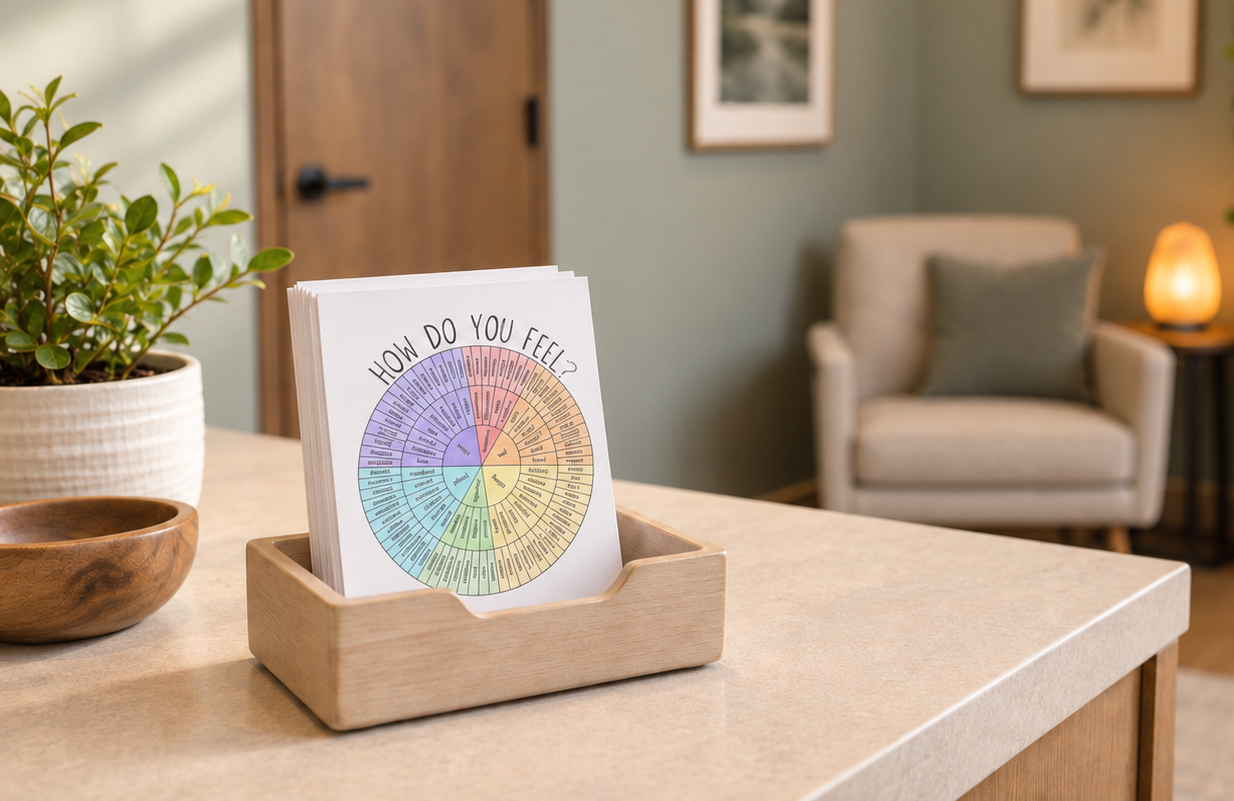
What I did was design one worth keeping in the room — durable enough for daily use, specific enough to get past the first ring, and available in whatever format your work actually calls for.
The standard
Every product gets held to one question: does this require real judgment to use well, or does it just look nice on a shelf?
If it's the second one, it doesn't get made. Practitioners have enough decorative wellness objects. What's harder to find is a tool that holds up in a session, a classroom, or a hard conversation.
If your work runs on precision, these were made for you.
HOW IT'S MADE
Built to hold up in the room it's used in.
A feelings wheel only earns a second use if it's worth picking up again. That's a materials question as much as a design one — here's what's behind it: the wheel itself, what it's made of, and how it gets made.
01 — The Wheel
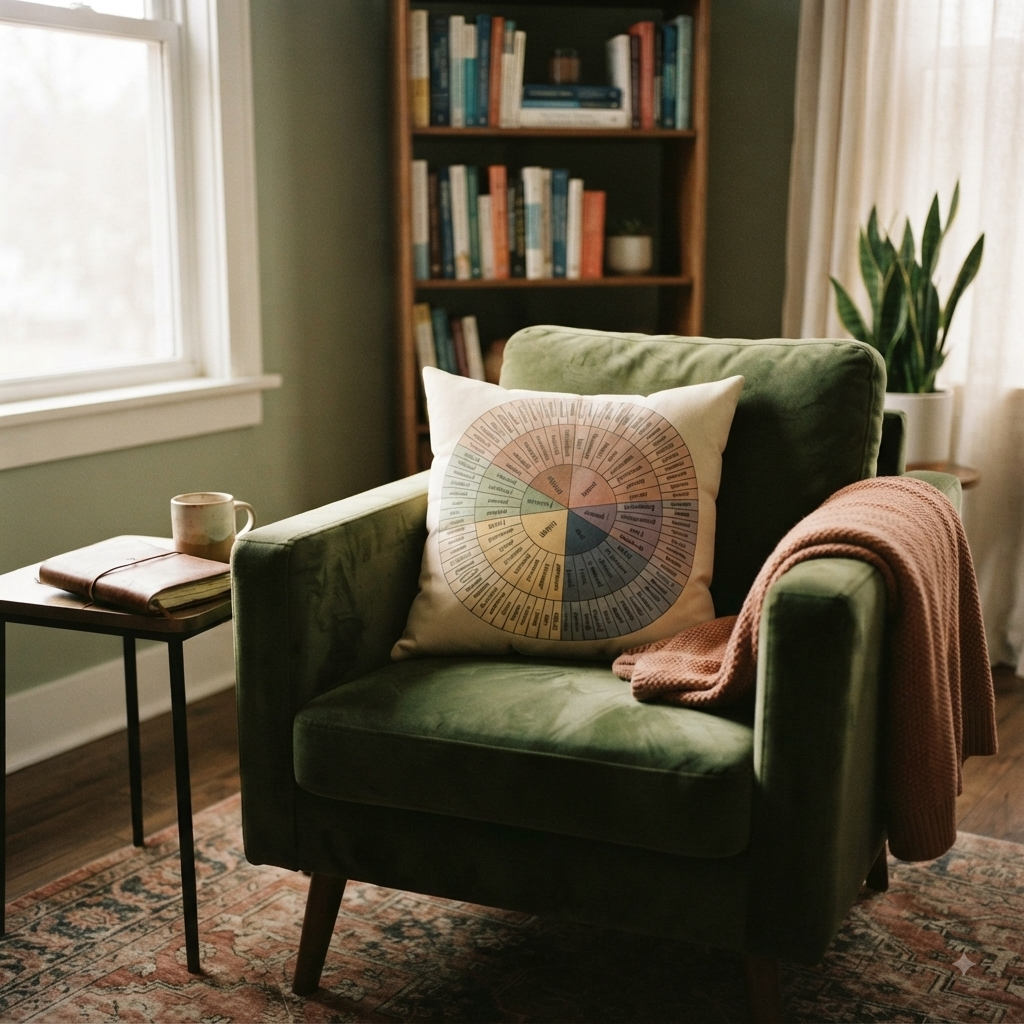
The feelings wheel isn't new, and IOW didn't invent it — it's a well-established way of naming emotion, radiating outward from six core feelings into more specific, nuanced ones. What's IOW's own is the execution: gradient rings that move from deep to light instead of flat, solid wedges; lowercase felt-state words instead of clinical capital-letter nouns; and a layout meant to be read at a glance, not studied like a chart. Picked up, not just posted.
02 — The Tools
Faux suede on the pillow. Baltic birch on the plaque, printed so the wood grain still shows through. Museum-grade paper on the posters. Every material was chosen for the room it ends up in — an office, a classroom, a waiting room — not for what's cheapest to produce. And every piece uses the same wheel and the same palette, so a practice can pair a pillow, a plaque, and a poster and have them look like they belong together.
03 — The Process
Nothing in the shop sits in a warehouse waiting to be sold. Every order is made once it's placed, by IOW's print partner, using a process suited to the material — UV printing on wood, archival ink on paper — built to hold up on a wall or a couch, not fade within a year. It also means no giant batch runs and no stockpile of a design that's stopped selling: what's listed is what's available.
EXPLORE IN OTHER WORDS
The wheel's ready when you are.